온라인강의
강사명Wonyoung Park
강의시간12분
강의개설일2025-12-09
강의소개
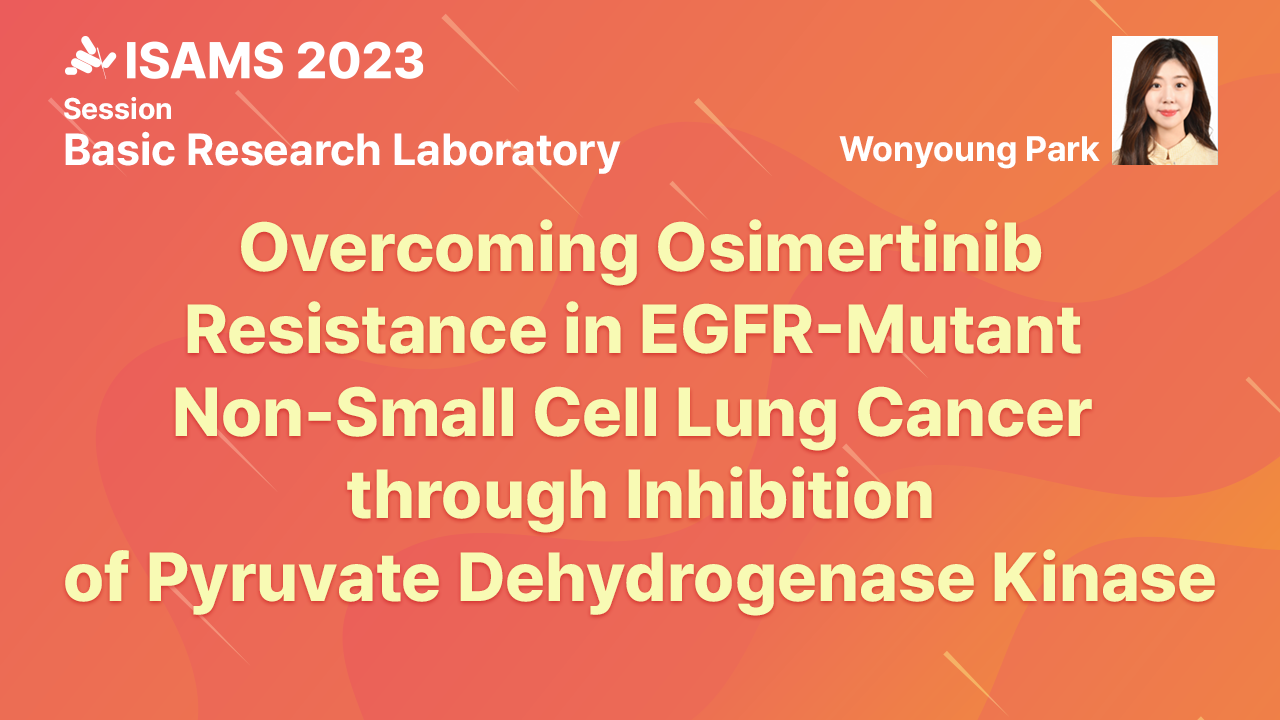
Background: Osimertinib, a third-generation epidermal growth factor receptor (EGFR) inhibitor, exhibits high
selectivity for the secondary acquired EGFR T790M mutation in non-small cell lung cancer (NSCLC). However, the
newly emerging EGFR C797S mutation confers resistance to osimertinib.
Objective: This study investigates the role of pyruvate dehydrogenase kinase 1 (PDK1) in osimertinib resistance in
NSCLC harboring the EGFR C797S mutation.
Methods: Expression levels of p-PDHA1 (S293) and PDK1 were assessed in lung cancer tissues obtained from 20
patients treated with osimertinib. Osimertinib-resistant cell lines with the EGFR C797S mutation were established using
NSCLC A549, NCI-H292, PC9, and NCI-H1975 cells. Glucose metabolism parameters, including glucose uptake,
lactate production, and oxygen consumption rate, were evaluated. DCA and leelamine were employed to treat NSCLC
EGFR-mutant cells. The PDK1 induction mechanism was elucidated using tofacitinib (a JAK inhibitor), U0126 (a MEK
inhibitor), LY294002 (a PI3K inhibitor), and YC-1 (a HIF-1α inhibitor). Xenograft and allograft models were established
by inoculating cancer cells containing the EGFR mutants into BABL/c nude or C57BL/6 mice, respectively.
Results: Osimertinib-resistant patients displayed elevated PDK1 expression. Osimertinib-resistant cells with the EGFR
C797S mutation exhibited increased cancer cell proliferation due to the activation of PI3K/AKT, MEK/ERK, and JAK/
STAT3 pathways. The EGFR C797S mutant stimulated glycolysis by upregulating PDK1 expression via the EGFR/AKT/
HIF-1α axis. Genetic knockout of PDK1 inhibited cell proliferation and tumor development. Moreover, the combination
of osimertinib with leelamine effectively overcame osimertinib resistance in allograft models.
Conclusion: Targeting PDK1, either genetically or pharmacologically, holds promise for overcoming osimertinib
resistance in EGFR C797S mutant NSCLC. This study sheds light on a potential therapeutic strategy to enhance
treatment outcomes for patients facing this challenging mutation.
강사소개
My name is Wonyoung Park, a dedicated and passionate researcher currently
engaged in postdoctoral training at the prestigious Korean Medical Research Center for
Healthy Aging, affiliated with Pusan National University. I hold a Bachelor's degree from Liaoning University of
Traditional Chinese Medicine, China, which laid the foundation for my academic pursuits. Building on this, I pursued
a Master's degree at Pusan National University, Korea, where I honed my research abilities and deepened my
understanding of the intricacies of biomedical science. My educational journey culminated in the attainment of a
Doctoral degree from the same esteemed institution in 2023, marking a significant milestone in my academic career.
Throughout my academic journey, my unwavering passion for cancer research has been a driving force. My research
interests revolve around the development of innovative therapeutic strategies to combat cancer, with a particular
focus on non-small cell lung cancer (NSCLC) and overcoming resistance to EGFR tyrosine kinase inhibitors (TKIs). My
doctoral research, titled "Overcoming Osimertinib Resistance in EGFR-Mutant Non-Small Cell Lung Cancer through
Inhibition of Pyruvate Dehydrogenase Kinase" exemplifies my commitment to addressing critical challenges in the field.