온라인강의
강사명Youngjoon Surh
강의시간38분
강의개설일2025-12-09
강의소개
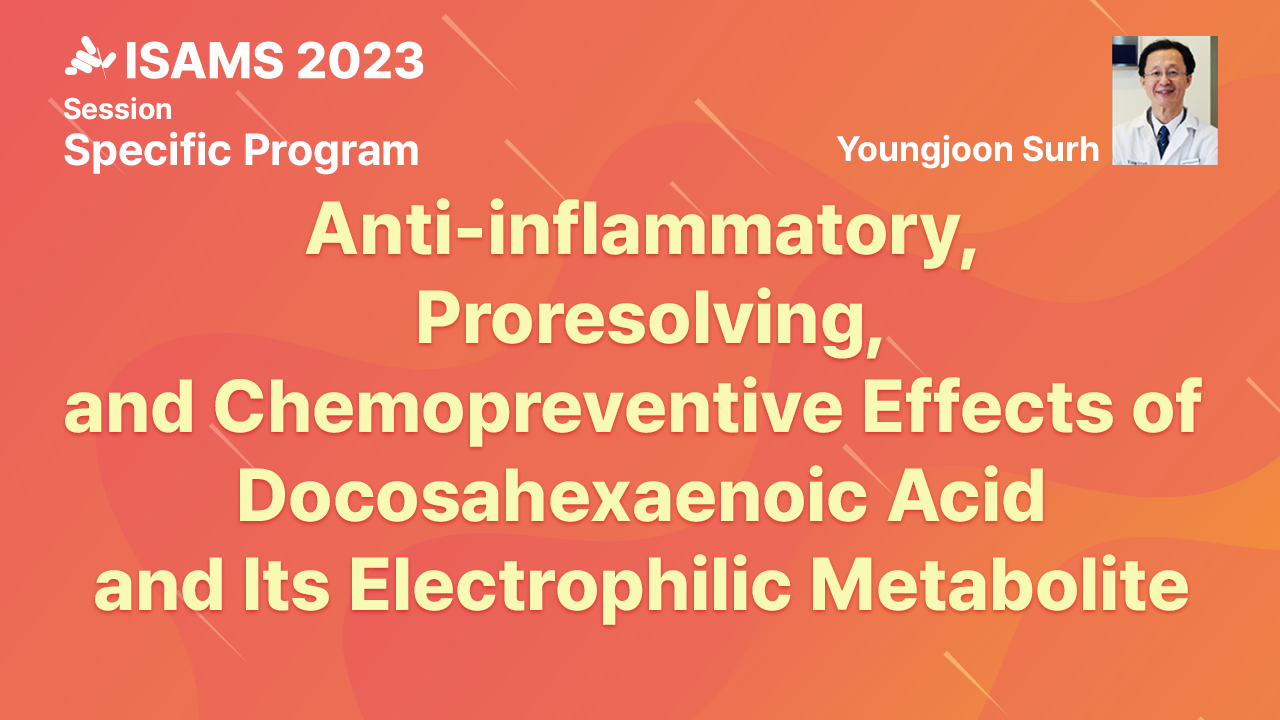
Docosahexaenoic acid (DHA), a representative ω-3 polyunsaturated fatty acid derived from fish oil, has been
reported to have a wide spectrum of health beneficial effects. Timely resolution of inflammation at the early stage is
important in preventing further progression to chronic inflammation and related disorders including cancer. Our recent
studies have revealed that DHA enhances the efferocytic activity of macrophage, an essential event in resolution of
inflammation. Moreover, DHA induced M2 macrophage polarization through peroxisome proliferator-activated receptor
γ activation. Further, transgenic mice harbouring fat-1 gene capable of generating spontaneously n-3 polyunsaturated
fatty acids including DHA were found to be less susceptible to experimentally induced murine colitis, skin inflammation,
and photocarcinogenesis. DHA undergoes metabolism to produce biologically active electrophilic species. 17-Oxo
DHA is one such reactive metabolite generated from DHA by cyclooxygenase-2 and dehydrogenase in activated
macrophages. Our recent studies have demonstrated the amelioration of ultraviolet B (UVB)-induced oxidative stress,
inflammation, and carcinogenesis in mouse skin as well as potentiation of efferocytic capability of murine macrophages
by 17-oxo-DHA on. These effects were attributable to inactivation of proinflammatory transcription factors, such as
NFkB and STAT3 and activation of the anti-inflammatory/proresolving transcription factor, NRF2. Therefore, DHA and its
electrophilic metabolite 17-oxo-DHA may have a preventive potential in the management of human cancer which arises
as a consequence of impaired resolution of inflammation as well as chronic inflammation.
강사소개
Prof. Young-Joon Surh graduated from College of Pharmacy, Seoul National University
with Bachelor’s and Master’s degrees. Prof. Surh earned a PhD degree at the University of Wisconsin
Madison and had postdoctoral training at Massachusetts Institute of Technology (MIT). After spending three and half years as a
tenure-track Assistant Professor at Yale University School of Medicine, he relocated to Seoul National University in 1996. Beside
his role as Editor-in-Chief of Journal of Cancer Prevention, Prof. Surh is currently Associate Editor of Molecular Carcinogenesis,
Toxicology & Applied Pharmacology, Free Radical Research, and Editorial Board member of many international journals. Prof.
Surh has published more than 400 papers in peer-reviewed international journals and about 70 invited editorials, reviews
and book chapters. The total number of citations of his publications is about 29,000 (excluding self-citations). The H-Index
reported by Thomson Reuter of Web Knowledge is 89. Thomson Reuter selected him as one of the 16 Korean scientists
whose publication is most highly cited. Prof. Surh received numerous awards including Elizabeth C. Miller and James A. Miller
Distinguished Scholar Award from Rutgers University (2011), McCormic Science Institute Award from American Society for
Nutrition (2009), Scientist of the Year Award from the Korea Science Reporters Association (2008), the Korea Science Award
given by President of South Korea (2013), etc. He currently serves as President of Society of Free Radical Research-Asia (SFRR
Asia) and Chair of Division of Medical Sciences, Korean Academy of Science and Technology (KAST).